Tikus kaki putih
| Tikus kaki putih | |
|---|---|
| |
Klasifikasi ilmiah 
| |
| Kerajaan: | Animalia |
| Filum: | Chordata |
| Kelas: | Mammalia |
| Ordo: | Rodentia |
| Famili: | Cricetidae |
| Subfamili: | Neotominae |
| Genus: | Peromyscus |
| Spesies: | P. leucopus
|
| Nama binomial | |
| Peromyscus leucopus (Rafinesque, 1818)
| |

| |

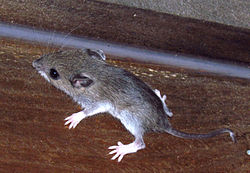
Tikus kaki putih[2] (Peromyscus leucopus) adalah sebuah spesies hewna pengerat asal Amerika Utara dari Kanada selatan sampai Amerika Serikat barat daya dan Meksiko.[1] Spesies tersebut adalah spesies dari genus Peromyscus, sebuah kelompok yang sangat berkerabat dengan tikus Dunia Baru yang seringkali disebut "tikus rusa". Di Maritimes, satu-satunya habitatnya adalah populasi terpisah di Nova Scotia selatan.[3] Spesies tersebut juga disebut sebagai tikus hutan, sebuah nama yang juga ditujukan kepada spesies tak terkait Apodemus sylvaticus, terutama di Texas.
Referensi
- ^ a b Linzey, A.V.; Matson, J. & Timm, R. (2008). "Peromyscus leucopus". Diakses tanggal 5 February 2010.
- ^ Halodoc, Redaksi. "Ini 6 Fakta tentang Hantavirus Pulmonary Syndrome". halodoc. Diakses tanggal 2026-03-27.
- ^ Atlantic Interior Diarsipkan 2012-09-16 di Wayback Machine., The Natural History of Nova Scotia
Bacaan tambahan
- Anderson JF, Johnson RC, Magnarelli LA (1987). "Seasonal prevalence of Borrelia burgdorferi in natural populations of white-footed mice, Peromyscus leucopus". Journal of Clinical Microbiology. 25 (8): 1564–1566. doi:10.1128/JCM.25.8.1564-1566.1987. PMC 269274. PMID 3624451.
- Rogic A, Tessier N, Legendre P, Lapointe FJ, Millien V (2013). "Genetic structure of the white-footed mouse in the context of the emergence of Lyme disease in southern Québec". Ecology and Evolution. 3 (7): 2075–2088. Bibcode:2013EcoEv...3.2075R. doi:10.1002/ece3.620. PMC 3728948. PMID 23919153.
- Barthold SW, Persing DH, Armstrong AL, Peeples RA (1991). "Kinetics of Borrelia burgdorferi dissemination and evolution of disease after intradermal inoculation of mice". The American Journal of Pathology. 139 (2): 263–273. PMC 1886084. PMID 1867318.
- Bunikis J, Tsao J, Luke CJ, Luna MG, et al. (2004). "Borrelia burgdorferi infection in a natural population of Peromyscus leucopus mice: a longitudinal study in an area where Lyme borreliosis is highly endemic". The Journal of Infectious Diseases. 189 (8): 1515–1523. doi:10.1086/382594. PMID 15073690.
- Brunner JL, LoGiudice K, Ostfeld RS (2008). "Estimating reservoir competence of Borrelia burgdorferi hosts: prevalence and infectivity, sensitivity, and specificity". Journal of Medical Entomology. 45 (1): 139–147. doi:10.1603/0022-2585(2008)45[139:ercobb]2.0.co;2 (tidak aktif 1 July 2025). PMID 18283955. S2CID 10702776. Pemeliharaan CS1: DOI nonaktif per Juli 2025 (link)
- Burgess EC, French JB Jr, Gendron-Fitzpatrick A (1990). "Systemic disease in Peromyscus leucopus associated with Borrelia burgdorferi infection". The American Journal of Tropical Medicine and Hygiene. 42 (3): 254–259. doi:10.4269/ajtmh.1990.42.254. PMID 2316794.
- Goodwin BJ, Ostfeld RS, Schauber EM (2001). "Spatiotemporal variation in a Lyme disease host and vector: black-legged ticks on white-footed mice". Vector-Borne and Zoonotic Diseases. 1 (2): 129–138. doi:10.1089/153036601316977732. PMID 12653143.
- Hofmeister EK, Ellis BA, Glass GE, Childs JE (1999). "Longitudinal study of infection with Borrelia burgdorferi in a population of Peromyscus leucopus at a Lyme disease-enzootic site in Maryland". The American Journal of Tropical Medicine and Hygiene. 60 (4): 598–609. doi:10.4269/ajtmh.1999.60.598. PMID 10348235.
- Horka H, Cerna-kyckovaa K, Kallova A, Kopecky J (2009). "Tick saliva affects both proliferation and distribution of Borrelia burgdoferi spirochetes in mouse organs an increases transmission of spirochetes by ticks". International Journal of Medical Microbiology. 299 (5): 373–380. doi:10.1016/j.ijmm.2008.10.009. PMID 19147403.
- Martin LB, Weil ZM, Kuhlman JR, Nelson RJ (2006). "Trade-offs within the immune systems of female white-footed mice, Peromyscus leucopus". Functional Ecology. 20 (4): 630–636. Bibcode:2006FuEco..20..630M. doi:10.1111/j.1365-2435.2006.01138.x.
- Martin LB, Weil ZM, Nelson RJ (2007). "Immune defense and reproductive pace of life in Peromyscus mice". Ecology. 88 (10): 2516–2528. Bibcode:2007Ecol...88.2516M. doi:10.1890/07-0060.1. PMC 7204533. PMID 18027755.
- Ostfeld RS, Miller MC & Hazler KR (1996) Causes and consequences of tick (Ixodes scapularis) burdens on white-footed mice (Peromyscus leucopus). J Mammal ; 77:266–273.
- Ostfeld RS, Schauber EM, Canham CD, Keesing F & al. (2001) Effects of acorn production and mouse abundance on abundance and Borrelia burgdorferi infection prevalence of nymphal Ixodes scapularis ticks. Vector Borne Zoonot Dis ; 1:55–63
- Pederson AB, Grieves TJ (2008) 'he interaction of parasites and resource cause crashes in wild mouse population. J Anim Ecol ; 77:370–377
- Schwan, TG, Burgdorfer, W, Schrumpf, ME, Karstens, RH. (1988) The urinary bladder, a consistent source of Borrelia burgdorferi in experimentally infected white-footed mice (Peromyscus leucopus). J Clin Microbiol ; 26:893–895
- Schwan TG, Kime KK, Schrumpf ME, Coe JE, et al. (1989). "Antibody response in white-footed mice (Peromyscus leucopus) experimental infected with the Lyme disease spirochete (Borrelia burgdorferi)". Infection and Immunity. 57 (11): 3445–3451. doi:10.1128/IAI.57.11.3445-3451.1989. PMC 259851. PMID 2807530.
- Schwanz LE, Voordouw MJ, Brisson D, Ostfeld RS (2011). "Borrelia burgdorferi has minimal impact on the Lyme disease reservoir host Peromyscus leucopus" (PDF). Vector-Borne and Zoonotic Diseases. 11 (2): 117–124. doi:10.1089/vbz.2009.0215. PMID 20569016. Diarsipkan dari asli (PDF) tanggal 2016-09-21. Diakses tanggal 2014-04-24.
Pranala luar
- White-footed Mouse, State University of New York, College of Environmental Science and Forestry
- White-footed Mouse, CanadianFauna.com
- White-footed Mouse, Canadian Biodiversity Website
 . Encyclopedia Americana. 1920.


 | Artikel bertopik biologi ini adalah sebuah rintisan. Anda dapat membantu Wikipedia dengan mengembangkannya. |
Konten ini disalin dari wikipedia, mohon digunakan dengan bijak.


