Ornithomimosauria
| Ornithomimosauria Rentang waktu: Kapur,
| |
|---|---|

| |
| Kumpulan tujuh ornithomimosauria, searah jarum jam dari kiri atas: Gallimimus, Anserimimus, Ornithomimus, Deinocheirus, Harpymimus, Struthiomimus dan "Gallimimus mongoliensis" | |
Klasifikasi ilmiah 
| |
| Kerajaan: | Animalia |
| Filum: | Chordata |
| Klad: | Dinosauria |
| Klad: | Saurischia |
| Klad: | Theropoda |
| Klad: | Maniraptoriformes |
| Klad: | †Ornithomimosauria Barsbold, 1976 |
| Subgroups[9] | |
| |
| Sinonim | |
| |

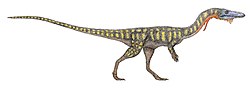
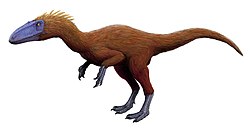
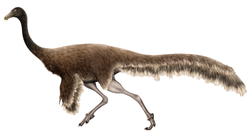
Ornithomimosauria, ("kadal menyerupai-burung") atau dinosaurus burung unta[10] adalah kelompok dinosaurus theropoda yang menyerupai burung unta modern. Dinosaurus ini merupakan dinosaurus omnivor atau herbivor yang dapat bergerak cepat. Dinosaurus ini hidup pada masa Kapur di Laurasia (kini Asia, Eropa, dan Amerika Utara), Afrika, dan kemungkinan Australia.[11] Kelompok ini pertama kali muncul pada masa Kapur Awal dan dapat bertahan hingga masa Kapur Akhir. Beberapa genus yang termasuk dalam kelompok ini adalah Nqwebasaurus, Pelecanimimus, Shenzhousaurus, Hexing, dan Deinocheirus, dengan panjang lengan yang mencapai 2,4 m. Terdapat pula famili Ornithomimidae, dan di dalamnya terdapat genus Gallimimus, Struthiomimus, dan Ornithomimus. Beberapa paleontolog (seperti Paul Sereno) menganggap Alvarezsauridae sebagai kerabat dekat ornitomimosaurus dan mengklasifikasikan keduanya ke dalam superfamili Ornithomimoidea.
Referensi
- ^ a b Holtz, Thomas R. Jr. (2012) Dinosaurs: The Most Complete, Up-to-Date Encyclopedia for Dinosaur Lovers of All Ages, Winter 2011 Appendix.
- ^ Hattori, Soki; Shibata, Masateru; Kawabe, Soichiro; Imai, Takuya; Nishi, Hiroshi; Azuma, Yoichi (2023-09-07). "New theropod dinosaur from the Lower Cretaceous of Japan provides critical implications for the early evolution of ornithomimosaurs". Scientific Reports (dalam bahasa Inggris). 13 (1): 13842. Bibcode:2023NatSR..1313842H. doi:10.1038/s41598-023-40804-3. ISSN 2045-2322. PMC 10484975. PMID 37679444.
- ^ Brownstein CD. (2016) Redescription of Arundel formation Ornithomimosaur material and a reinterpretation of Nedcolbertia justinhofmanni as an "Ostrich Dinosaur": Biogeographic implications. PeerJ Preprints 4:e2308v1 https://doi.org/10.7287/peerj.preprints.2308v1
- ^ Choiniere, J. N.; Forster, C. A.; De Klerk, W. J. (2012). "New information on Nqwebasaurus thwazi, a coelurosaurian theropod from the Early Cretaceous (Hauteriverian?) Kirkwood Formation in South Africa". Journal of African Earth Sciences. 71–72: 1–17. Bibcode:2012JAfES..71....1C. doi:10.1016/j.jafrearsci.2012.05.005.
- ^ Cerroni, M.A.; Agnolin, F.L.; Brissón Egli, F.; Novas, F.E. (2019). "The phylogenetic position of Afromimus tenerensis Sereno, 2017 and its paleobiogeographical implications". Journal of African Earth Sciences. 159: 103572. Bibcode:2019JAfES.15903572C. doi:10.1016/j.jafrearsci.2019.103572. S2CID 201352476.
- ^ Cuesta E, Vidal D, Ortega F, Shibata M, Sanz JL (2021). "Pelecanimimus (Theropoda: Ornithomimosauria) postcranial anatomy and the evolution of the specialized manus in Ornithomimosaurs and sternum in maniraptoriforms". Zoological Journal of the Linnean Society. 194 (2): 553–591. doi:10.1093/zoolinnean/zlab013.
- ^ Sereno, P. (2017). "Early Cretaceous ornithomimosaurs (Dinosauria: Coelurosauria) from Africa". Ameghiniana. 54 (5): 576–616. Bibcode:2017Amegh..54..576S. doi:10.5710/AMGH.23.10.2017.3155. S2CID 134718338.
- ^ Jin Liyong, Chen Jun & Pascal Godefroit (2012). "A New Basal Ornithomimosaur (Dinosauria: Theropoda) from the Early Cretaceous Yixian Formation, Northeast China". Dalam Godefroit, P. (ed.). Bernissart Dinosaurs and Early Cretaceous Terrestrial Ecosystems. Indiana University Press. hlm. 467–487. Bibcode:2012bdec.book.....G.
- ^ Kesalahan pengutipan: Tanda
<ref>tidak sah; tidak ditemukan teks untuk ref bernamaleeetal2014 - ^ "Ostrich dinosaurs".
- ^ "New information on Nqwebasaurus thwazi, a coelurosaurian theropod from the Early Cretaceous Kirkwood Formation in South Africa". Journal of African Earth Sciences. 71–72: 1–17. doi:10.1016/j.jafrearsci.2012.05.005.
Bacaan lanjut
- Barrett, P. M. (2005). "The diet of ostrich dinosaurs (Theropoda: Ornithomimosauria)". Palaeontology. 48: 347–358. doi:10.1111/j.1475-4983.2005.00448.x.
- British Museum (Natural History): Ostrich Dinosaurs
- Jacobsen, A.R. 2001. Tooth-marked small theropod bone: An extremely rare trace. p. 58-63. In: Mesozoic Vertebrate Life. Ed.s Tanke, D. H., Carpenter, K., Skrepnick, M. W. Indiana University Press.
- Li Xu; Yoshitsugu Kobayashi; Junchang Lü; Yuong-Nam Lee; Yongqing Liu; Kohei Tanaka; Xingliao Zhang; Songhai Jia; Jiming Zhang (2011). "A new ornithomimid dinosaur with North American affinities from the Late Cretaceous Qiupa Formation in Henan Province of China". Cretaceous Research. 32 (2): 213–222. doi:10.1016/j.cretres.2010.12.004.[pranala nonaktif permanen]
- Molnar, R. E., 2001, Theropod paleopathology: a literature survey: In: Mesozoic Vertebrate Life, edited by Tanke, D. H., and Carpenter, K., Indiana University Press, p. 337-363.
- Nicholls, E. L.; Russell, A. P. (1985). "Structure and function of the pectoral girdle and forelimb of Struthiomimus altus (Theropoda: Ornithomimidae)". Palaeontology. 28: 643–677.
- Norell, M. A.; Makovicky, P.; Currie, P. J. (2001). "The beaks of ostrich dinosaurs". Nature. 412: 873–874. doi:10.1038/35091139. PMID 11528466.
- Schmitz, L.; Motani, R. (2011). "Nocturnality in Dinosaurs Inferred from Scleral Ring and Orbit Morphology". Science. 332 (6030): 705–8. doi:10.1126/science.1200043. PMID 21493820.
- Sereno, P. C. 2005. Stem Archosauria—TaxonSearch Diarsipkan 2009-01-15 di Wayback Machine. [version 1.0, 2005 November 7]
- Tanke, D.H. and Brett-Surman, M.K. 2001. Evidence of Hatchling and Nestling-Size Hadrosaurs (Reptilia:Ornithischia) from Dinosaur Provincial Park (Dinosaur Park Formation: Campanian), Alberta, Canada. pp. 206–218. In: Mesozoic Vertebrate Life—New Research Inspired by the Paleontology of Philip J. Currie. Edited by D.H. Tanke and K. Carpenter. Indiana University Press: Bloomington. xviii + 577 pp.
- Turner, A.H.; Pol, D.; Clarke, J.A.; Erickson, G.M.; Norell, M. (2007). "Supporting online material for: A basal dromaeosaurid and size evolution preceding avian flight". Science. 317 (5843): 1378–1381. doi:10.1126/science.1144066. PMID 17823350. (supplement)




 | Artikel bertopik dinosaurus ini adalah sebuah rintisan. Anda dapat membantu Wikipedia dengan mengembangkannya. |
Konten ini disalin dari wikipedia, mohon digunakan dengan bijak.


